Validated > 99% Lab-grade Peptides
Peptide Pureness Evaluation Service
We employ GC-MS, ICP-MS, and other methods to identify impurities, ensuring item safety and security and regulative conformity. Peptide sequencing is important for recognizing the specific amino acid series of peptides, consisting of modifications like phosphorylation or acetylation. Sequencing enables scientists to recognize the organic function of the peptide and its interaction with other molecules, aiding in the layout of useful peptides for varied applications. The peptide sample is dissolved in a compatible solvent and packed into an autosampler.At Maxed Out Compounds, every item we provide comes with a clear testing document and clear paperwork. Our mission is to sustain scientists with high-purity, confirmed substances that meet the needs of contemporary clinical research study-- nothing even more, absolutely nothing much less. Independent, third-party testing plays a crucial function in making certain objectivity and accuracy. By using outside laboratories for confirmation, providers remove prejudice and maintain clinical integrity. It's an added action that gives researchers confidence that each peptide satisfies regular, verifiable standards. This quality suits most of artificial insemination study applications-- receptor binding assays, enzyme activity research studies, and cell society experiments.
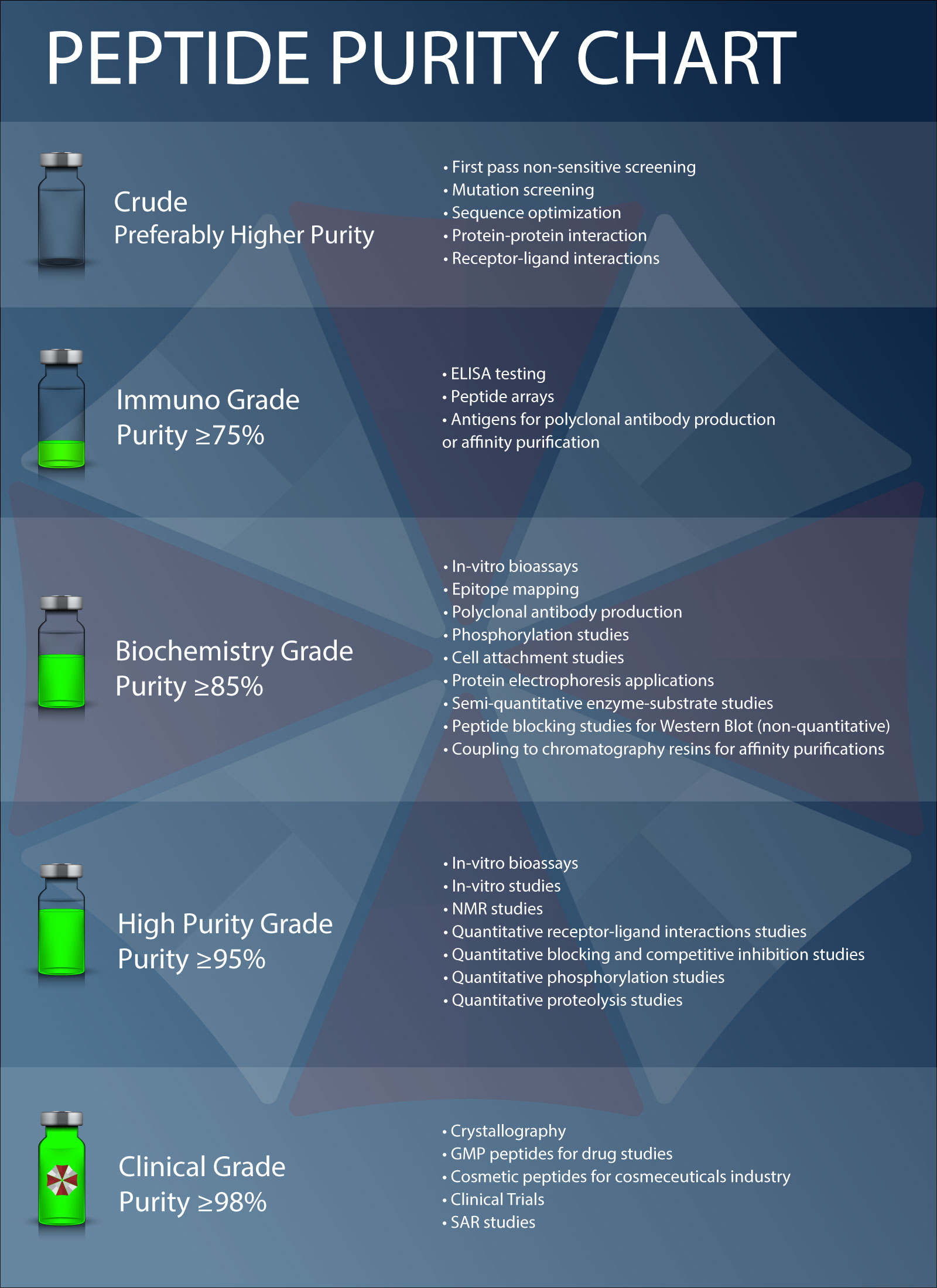
It is an area-percent purity measurement, not a complete identity or task test. Notably, pureness portions describe chemical structure just-- they do not show sterility or organic suitability. Peptides from Maxed Out Substances are supplied solely for lab study usage and are not meant for human or vet functions. Peptide purity is typically expressed as a portion, such as 95% or 98%. This number stands for how much of the sample is composed of the preferred peptide sequence. For the majority of research laboratory applications, a purity of 95% or higher is taken into consideration research-grade.- The table listed below is the practical way to think of common tests when reading a peptide COA.
- Peptide purity screening data are compulsory in preclinical researches and should be included in investigational brand-new medicine (IND) applications and later new medication applications (NDAs).
- We make logical workflows around the sample type, series functions, alteration profile, and choice context.
- Recurring natural solvents, metal ions, or byproducts from synthesis might trigger poisonous side effects.
- The pump keeps exact flow prices, commonly in the series of 0.5 to 2.0 mL/min depending upon the approach and column layout.
- Be cautious of COAs that provide a pureness number with no sustaining chromatographic information, record pureness without specifying the logical technique, or list a molecular weight without mass spectrometry verification.
Pinnacle Research Laboratory Content Group
High-performance Liquid Chromatography

During solid-phase synthesis, each amino acid combining step has a return of roughly 99-- 99.8%. When a coupling fails, the growing chain is capped to prevent further prolongation of the incorrect sequence. The outcome is a peptide that's shorter than meant-- missing several amino acids.
While peptide purity isn't the only aspect, utilizing inadequately identified reagents is an acknowledged contributor to irreproducible outcomes. For a 10-residue peptide with 99.5% coupling efficiency, you would certainly expect regarding 95% of the end product to be the unabridged series prior to purification. For a 30-residue peptide at the same effectiveness, that goes down to roughly 86%. This is why longer peptides are more challenging to produce at high purity and usually set you back more. Purity is the portion of publications in the delivery that have every web page published appropriately, in the appropriate order, without any missing chapters and no extra pages packed in. A 95% purity implies that out of every 100 "publications" in your set, 95 are best copies and 5 have some sort of error. An example might create a clean-looking chromatogram with one leading top and still be the wrong compound if identification was never validated. HPLC measures splitting up and relative peak area; mass spectrometry actions mass-to-charge habits that can be used to confirm molecular identity. Peptide purity testing is the process of confirming that a peptide example consists of just the intended sequence-- and no significant contaminants or by-products from synthesis. Since peptides are created with complicated chemical processes, trace impurities can create normally. Testing enables scientists to understand specifically what's in the vial, verifying both identification and quality. Picking a trusted third-party laboratory is vital to obtaining reputable peptide validation results.